 Monroe, NC · since 2000

What does interior painting cost in Union County, NC? Angi's national average is $2,022, in a range of $350 to $5,800, but your number is set by the walls rather than the square footage. Before I give a rough number by text or email I ask four things: how many colors, what sheen, what repairs the walls need, and whether the trim stays white.
Start with the national figure, then put it down
According to Angi's interior painting cost guide, updated in July 2026, the national average cost to paint the interior of a house is $2,022, within a total range of $350 to $5,800, or roughly $2 to $6 per square foot.
That figure is real and well sourced, and it is close to useless for planning your own job. The top of the range is more than sixteen times the bottom, which tells you the average is not describing any house in particular. We do not publish our own price bands here, because the number for your house depends on the things below.
One request, and the four questions it got
In October 2026 someone buying a house in Monroe asked us, through this site, for a rough quote. They wanted the whole interior repainted: every room including the closets, all the trim and doors, and only one ceiling. Text or email preferred.
My reply asked four things before any number: how many colors, what sheen, any repairs to the walls, and whether the trim was going back white if that is what it was now. I also told them plainly that "until I actually looked at it, just know it could be a little different."
Every one of those questions maps onto the price. Closets are small rooms with a lot of cutting in. Doors are slow, two sides and an edge each. A single ceiling instead of all of them takes a real line off the job. Trim going back white is quick; trim changing color is not. And repairs are the item nobody can see in a message.

The six things that decide your number
These are what separate a job at the bottom of that range from one at the top. Only one of the six is about size.
| What we look at | Cheap end | Expensive end |
|---|---|---|
| Wall condition | Sound walls, a few nail holes | Cracks to cut and tape, damaged drywall to skim, old wallpaper adhesive |
| Amount of trim | Plain baseboard, flat doors | Crown, chair rail, wainscot, panelled doors, built-ins |
| Color change | Same shade, or a slight shift | Dark to light, or a strong color that needs a tinted primer |
| Ceilings | Flat, painted, in good order | Textured, stained, or popcorn that wants removing first |
| Access and occupancy | Empty house, ground floor | Occupied, furnished, stairwells, two-story voids |
| Number of colors | One or two through the house | A different color per room, each one a separate cut-in |
Color is the one people underestimate. Going from a dark wall to a light one usually needs a primer coat before the two finish coats, and a house with a different color in every room means a separate cut-in line at every ceiling and every piece of trim. Keeping the trim white where it is white already is one of the simplest ways to hold a price down, which is why it was one of the four questions in that reply.
Why preparation is the whole argument
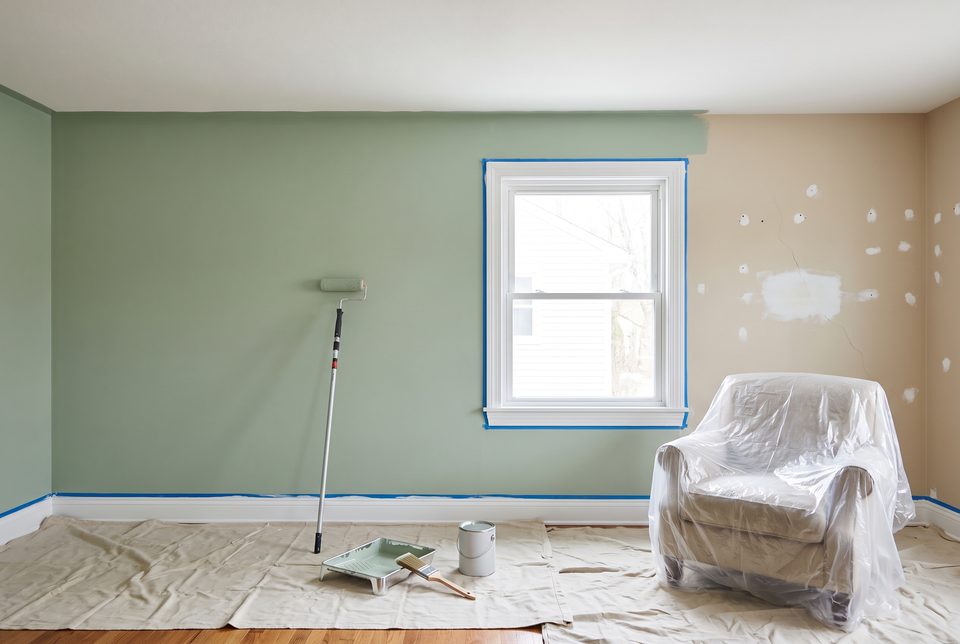
Most of the labor on a repaint goes into getting the wall ready for the paint. Filling nail holes is quick. Cutting out a settlement crack, taping it, skimming it, sanding it flat and spot-priming it so the repair does not flash through the finish can take far longer than painting that wall. Two houses of the same size can be far apart on that alone, and the difference only shows when low light comes across the finished wall.

Old wallpaper is the other hidden line. Stripping it is slow, the adhesive left behind has to be washed off completely, and the wall underneath often needs skimming before it will take paint without the seams showing through.
An older house adds one more line. If it was built before 1978, the US Environmental Protection Agency requires firms paid to disturb more than a small area of its paint to be EPA-certified and to follow lead-safe practices, which means containment and careful cleanup. The EPA's consumer page puts the stakes plainly:
“Home RRP projects that create even a small amount of lead dust are enough to poison your child and put your family at risk.”
US Environmental Protection Agency, Renovation, Repair and Painting Program (consumer page)
Paint before you move in, if you can
A house between closing and moving in is the cheapest it will ever be to paint: no furniture to shift and cover, no rooms that have to stay usable, and a crew that can move from one room to the next without waiting. Once the boxes arrive, every room has to be emptied to the middle, covered, painted and put back, and the job runs in smaller pieces.
The same goes for a bigger project. One of our older listings, a 2013 job in Mint Hill, had a wall taken out and a beam put in, the washer supply and dryer vent moved, new tile in the halls, and a complete repaint at the end. When the walls are already open and the floors already covered, the repaint rides on the same setup. Painted on its own a year later, it would start from scratch.

What to send us for a rough number
If you want a number before anyone visits, this is the list that makes it a useful one. It is the same list I asked that buyer for, with a few things added that change the price just as much:
- Which rooms, and whether closets are included.
- Ceilings: all, some or none. One ceiling is a very different job from twelve.
- Doors and trim, and whether the trim stays the color it is now.
- How many wall colors, and the sheen you want.
- Any repairs you already know about: cracks, holes, water stains, old wallpaper.
- Whether the house is empty or lived in, and roughly when it was built.
Photos help with the last two. They do not show how sound a wall is, which is why the written price waits for a visit.
How to read a quote that looks too good
We would rather lose a job on price than win it with a number that leaves out the prep. When two estimates for the same rooms are far apart, the gap is almost never profit margin. It is scope. Read both for these five things and the difference usually explains itself.
- How many coats, and over what. Two coats over an unprepared wall is not two useful coats.
- Whether the words patch, sand and prime appear. “Prep as required” means whatever the contractor decides on the day.
- Trim and ceilings, included or listed as extras.
- A product and a sheen for each surface, or just “paint”.
- What happens when damage turns up behind the furniture: a conversation with a price, or a change order after the fact.
Getting a number you can actually use
An estimate from us is free, happens in person, comes in writing, and already includes the repair we can see, with no obligation attached. If you want a rough number first, send the list above by text or email and we will reply with one.
We work across Monroe and the rest of Union County, where houses run from older homes with layers of paint to newer builds with builder-grade flat finishes. Both change the prep: the first may need lead-safe work, the second usually needs a washable sheen in the rooms that get used hardest.
If you are still deciding what you want done, the sheen guide is worth reading first. Specifying the right finish per room costs nothing at quote stage and is the difference between a hallway that cleans and one that burnishes. And if the job involves kitchen cabinets, that is a different calculation. One homeowner's Google review describes the whole-house version of this job: popcorn ceilings removed and made smooth, and almost the entire inside of the house painted, alongside a new kitchen floor and refinished hardwood.
- US Environmental Protection Agency, Lead Renovation, Repair and Painting Program, epa.gov – certification for paid work that disturbs paint in homes built before 1978.
- US Environmental Protection Agency, Renovation, Repair and Painting (RRP) Program: information for consumers, epa.gov – the source of the pull quote above.
- Angi, How Much Does It Cost to Paint the Interior of a House? — national average $2,022, with a total range of $350 to $5,800 and $2 to $6 per square foot. angi.com
Interior painting costs
Before you ask for a number.
Not covered? Call (980) 372-6258, weekdays 9 to 5.
Can you give me a rough price by text or email?
Yes, a rough one. Tell us how many colors, what sheen, whether the walls need repairs, and whether the trim stays white, and we can send a number. It can still move once we have seen the rooms, because patching and access are hard to judge from a description; the written estimate comes after the visit.
Is it cheaper per room if I do the whole house at once?
Usually, yes. The fixed costs of a job, getting there, setting up, masking and cleaning up, get spread across more rooms, so the per-room figure falls without changing the spec.
Does an empty house cost less to paint?
Yes. No furniture to move, cover and put back, and the crew can work continuously rather than room by room. If you are painting between closing and moving in, say so, because it changes the number.
How do I compare two quotes that are far apart?
Read what each says about preparation and coats, not the total. A quote that says “two coats” and a quote that says “patch, sand, spot-prime, two finish coats” are pricing different jobs. If one is much cheaper and says less, it is usually cheaper because it is doing less.
Do you charge by the square foot?
No. Square footage is a poor predictor on a repaint because it ignores the condition of the surface, the amount of trim and the number of colors. The written price comes from walking the rooms.
Does an older house cost more to paint?
Often. A house built before 1978 may have lead paint under the newer coats, and the EPA requires firms paid to disturb more than a small area of it to be certified and to work lead-safe, which adds containment and cleanup to the prep. Tell us the age of the house when you ask for a number.
Get a free estimate
Tell us the rooms and the town.
A visit, a written number that includes the patching, the sanding and the priming, and no obligation to do anything with it.